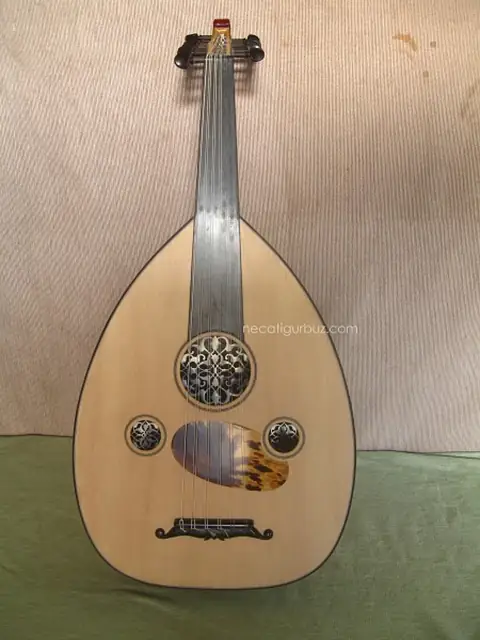
History of the oud
Origins
Instruments of the lute family appear in the art of ancient Mesopotamia and Egypt. The barbat of Sasanian Iran is usually named as the close ancestor of the oud.
The Islamic world
From the 7th century the oud became the central instrument of Arab music. Its name comes from the Arabic al-ʿūd, “the wood”. Thinkers such as al-Kindi and al-Farabi explained music theory on it.
Andalusia and Europe
Through Andalusia the oud reached Europe and gave rise to the lute, whose very name derives from al-ʿūd.
Ottoman period
Played at the Ottoman court, the oud receded for a time and spread again in the late 19th century. The ouds of the Istanbul maker Manol are still a reference today.
Today
Today the oud is both a solo and an ensemble instrument in Turkish and Arab music. Its fretless fingerboard suits the fine intervals of makam; most have eleven strings, five pairs and one single.